Islamic finance provides financial
services in accordance with Shariah (Islamic law) principles, which
prohibit interest (riba) and speculative risk, and require profit/loss
sharing and linkage to real assets. This distinct ethical foundation
creates unique corporate governance challenges that extend beyond those
of conventional finance. A central issue is how to ensure ongoing compliance in the face of resource scarcity and competing structures.
Furthermore,
the industry grapples with the tension between adopting international
standards designed for conventional, debt-based
systems, and developing its own tailored frameworks. Global bodies have developed alternative - voluntary standards, but
widespread mandatory adoption remains elusive, leading to fragmentation
across jurisdictions. Key unresolved questions resonate around standards, shariah and the driving need for innovation.
Ultimately, stronger governance is vital for the
industry's stability, growth, and ability to achieve its broader
economic objectives, positioning Islamic finance as a significant
contributor to the global financial system.
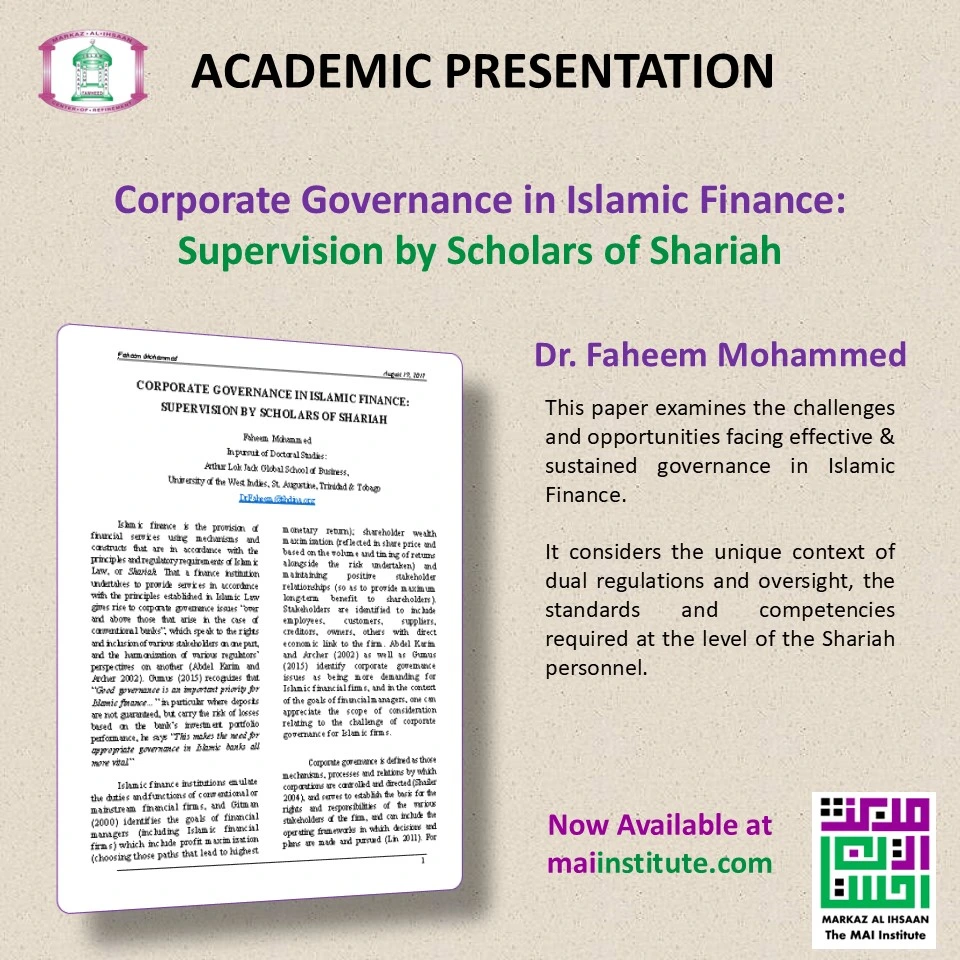
This paper was presented at a Doctoral Seminar on Financial Management at the Arthur Lok Jack Global School of Business,University of the West Indies, St.
Augustine, Trinidad & Tobago on 19 August 2017.